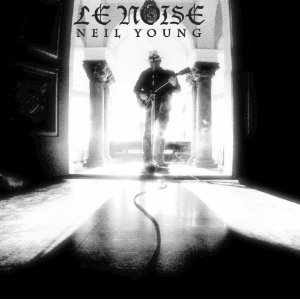
Reporting back finally on the May 3rd trip to Cincinnati to see Neil Young in a solo concert. In this case, solo did not mean laid-back and quiet. Young is touring behind his latest album Le Noise, which is also solo, using only guitars (usually electric) treated with studio effects by producer Daniel Lanois, known for his work with U2 and Peter Gabriel. So though Young did dig back into his catalog for some gems ("Cinnamon Girl," "After the Gold Rush," "Cortez the Killer"), almost half of the show was comprised of songs from the new album. Lyrically, the new songs are nothing special--mushy but noisy love songs ("Walk With Me," "Sign of Love") and long confessional (and noisy) songs about his life and career ("Hitchiker," "Love and War"). But musically, they're interesting, or maybe I should say "sonically," as most of the interest comes from the layers of echo and feedback on each track.
In concert, Young achieved most of the atmospheric effects through volume--loud and noisy but not enough to call for earplugs--and feedback, though he opened the show with a fairly quiet set on acoustic guitar ("My, My, Hey, Hey," "Tell Me Why," "Helpless"). What surprised me most was how clear and strong Young's voice is. His vocal trademark is usually closer to whiny and fragile, but here, even at the age of 65, his voice sounded better than ever. Because Young has been know to be a bit of a contrarian in concert, deliberately withholding his big hits and playing lesser-known and unreleased stuff, I was pleasantly surprised to hear these three early songs. He then did an unreleased song, "You Never Call," which seemed to be Young complaining about a friend who had passed on who never calls from Heaven, followed by a batch of songs from Le Noise.
After every song or two, he would put down whatever instrument he was playing (guitar, harmonica) and meander about the stage to choose another instrument (piano, pump organ). It looked very casual and almost improvised, although apparently his set list never varied a bit during this tour. He performed a lovely new song called "Leia," about (I assume) his granddaughter, and did a sublime version of "After the Gold Rush" at the organ, which brought tears to my eyes. Another quiet moment was his piano version of "I Believe in You." The biggest surprise of the night was his protest-song hit from his CSNY days, "Ohio," appropriate not only because he was in Ohio but because the next day, May 4th, would be the 41st anniversary of the Kent State shootings, the subject of the song.
But the hardcore fans were probably happiest when he dragged out three rockers from the old days: "Cortez the Killer," "Down By the River," and my favorite, "Cinnamon Girl" (see the video below from a live show in New York a few years ago) and did them justice even without a backing band. People around us were yelling for "Old Man," but really, can a man who is now officially a senior citizen sing that song without seeming deluded? I looked around me and noticed how old everyone looked--the dressed-to-the-niners, the bleary-eyed hippies in their tie-dyed t-shirts--and then realized that most of these folks were my age (mid-50s) or younger. An unwanted epiphany that did not spoil a great show.
Over the past year, I've become good friends with a co-worker (or “bro-worker,” as he was dubbed by yet another co-worker); let’s call him Neil. We initially bonded over music; though our tastes were not especially similar (he likes punk and U2, I like 60s bubblegum and the Beatles), we found common ground with New Order. He turned me into a fan of Joy Divison and, well, he at least tolerates most of the bright glossy pop confections on my iPod. But we also discovered that we are both fans of Neil Young. So when we found out that Young was playing Cincinnati in May as part of his current solo tour, we made plans to go.
Neil Young has spent the last 40-some years flying high and low, in, around and through the pop culture radar, and he remains one of the few rock musicians from the 60s to sustain a viable career making new music and continuing to hit the album charts with relative frequency well into the 21st century--his latest album Le Noise hit the top 20 when it was released last fall.
One reason he's lasted this long may be his chameleon-like quality. Like Madonna (yes, I'm comparing Neil Young to Madonna), Young has re-invented his image and his music frequently, and in doing so brought new and younger fans into his circle. I imagine the average pop music listener thinks of Young as a folkie; he began his career in 1967 with folk-rock group Buffalo Springfield, his only top 10 hit was 1972’s "Heart of Gold," a folkie-strummer if you ever heard one, and most of his highest-charting albums (Harvest, Comes A Time, Harvest Moon) have a quiet folk-country vibe.
But most of his hardcore fans think of him as a rock & roller, pure and simple--though he's anything but pure and simple. From the beginning he was hard to pin down; his Buffalo Springfield songs were squarely in the pop-folk genre except for the suite-like 6-minute "Broken Arrow" with its almost avant-garde use of atmospheric sound (you can’t really dance--or even sway--to it) and the slow, slightly spooky "Expecting to Fly," with its opening and closing chords right out of the Beatles’ "Day in the Life" by way of Enya. On his second solo album he produced three lasting FM radio rock classics: "Cinnamon Girl," "Down By the River," and "Cowgirl in the Sand."
After Harvest and "Heart of Gold," Young produced three albums that have become known among fans as the Ditch Trilogy, because on the liner notes to his compilation album Decade, he says he took a detour out of the middle of the road and into the ditch. All three albums (Time Fades Away, On the Beach, and especially Tonight's the Night) are sloppy, almost primitive sounding--an early grunge style, maybe--and filled with performances which were largely alcohol-and-drug induced, and songs with depressing and defensive lyrics, some about the dark side of the drug world, triggered by the deaths of band member Danny Whitten and roadie Bruce Berry. These were not big sellers, but they cemented Young’s "street cred," so to speak, among his harder-rocking fans.
In 1979, he recovered commercially with Rust Never Sleeps, an album that is almost exactly 50% folkish acoustic songs and 50% noisy rockin'-out songs with his grungy band Crazy Horse. Probably if the average person knows any other Neil Young song besides "Heart of Gold," it’s "Hey, Hey, My, My" with the line, "It's better to burn out than to fade away," which became notorious after Kurt Cobain quoted it in his suicide note. Since then, he has recorded rockabilly, electronic music, more folk, more noisy rock, protest songs, love songs, and hit a late-career high in the mid-90s when he cut an album (Mirror Ball) with Pearl Jam. Of course, I guess since he’s still going strong in 2011, "late-career" is not the right phrase.
My friend Neil considers himself a diehard Neil Young fan, knowing obscure songs and lyrics (like "Last Trip to Tulsa": "Well I woke up in the morning/With an arrow through my nose/There was an Indian in the corner/Tryin' on my clothes") and having seen him in concert many times over the years. But I probably know more, "academically" speaking, about Young's career and personality--at least partly because I read the huge biography Shakey. Neil and I come at Neil Young from different sides of the 1977 career hinge Decade, a 3-LP set collected from the albums of his first ten years. My favorite Young albums are all pre-1980 (After the Gold Rush, Comes a Time, and Rust Never Sleeps); my friend Neil doesn't seem to think in terms of favorite albums, but he knows very little from Young's early days except what's on Decade, tends to like Young's long crazy songs such as "Tulsa," "Like a Hurricane," "Cowgirl in the Sand," and "Cortez the Killer," and he's a fan of the Kraftwerk-like electronic album Trans. So I imagine on our road trip to Cincy on Tuesday, we'll give each other crash courses on our areas of expertise. I'm looking forward to a long strange trip and will report back on the concert soon. (The video below is of "Sample and Hold," one of the Trans songs)
The Illumination by Kevin Brockmeier sold itself to me based on this plot description: one evening, all over the world, pain begins to emit light. A flesh wound, a cold sore, a headache, cancer; all physical pain manifests itself with light which, in the language of the book jacket, glitters, fluoresces, blazes. I knew this would not be science fiction, for the rest of the plot description makes clear that the book will tell the stories of six people who all experience various kinds of pain and who all have contact with a notebook that is a collection of daily love notes left by a husband for his wife.
This book is really a loosely-knit short story cycle, the kinds of stories you'd find in the New Yorker--that's not mean to be a compliment or an insult, just a description. Ultimately, it struck me that both the "Illumination" and the notebook were gimmicks in order to have a framework for otherwise unconnected narratives. Most of the individual stories are interesting, but I wound up being disappointed that the gimmicks didn't amount to much. The plot point of pain emitting light is not crucial to any of the stories; it adds some nice grace notes here and there, but very little is done with it. Is it science or God or something else entirely? One story, about a missionary, seems about to touch on the spiritual nature of the Illumination, but it goes nowhere.
The notebook with its single sentence love notes ("I love how quietly you speak when you're catching a cold"; "I love how you fumble for words when you're angry"; "I love the joke you told an Eli and Abby's wedding reception") winds up being more important to the characters. Each of the six characters takes possession of the book, reads from it, and wonders about its origin; one of the stories is about the man who wrote the notes, which his wife, now deceased, kept in the notebook. One story is about a writer, suffering from terrible mouth pains (ulcers, cancre sores, etc.) who draws inspiration from the notebook for a story she writes.
Even though I felt tricked and let down by the book, I thought most of the stories were worth reading. One is a little creepy: a photojournalist takes a picture of a high school girl cutting herself in public (perhaps to see the Illumination, though her reasons are not clear), winds up taking her in when her parents throw her out, and by the end of the story has joined her in her flesh-cutting activities. The story about the writer is the most interesting one, and it has the added bonus of a story-within-the-story that she writes about communicating with the dead.
The overwhelming feeling I got from the book was sadness. Perhaps because recently I've had to deal in relatively minor ways with the aches and pains of aging, I was touched by the descriptions of physical suffering here, but each character is also going through incredible emotional pain as well. Sometimes, as in the story the husband with the notebook, the tone almost becomes too much to bear. At other times, as with the missionary, it's difficult to pin down what the suffering is about. But rarely have I had a book leave me in such strange, ambiguous moods each time I put it down. Recommended for readers of, well, The New Yorker.
Netflix streaming is a wonderful thing--on a whim, thousands of movies are available to watch at home, whenever you want. Hit movies, cult films, classics, and best of all, little oddities that you might never have searched out, but run across doing a random search on genres. While looking for a Friday night horror movie, I found this oddity from 1986, From a Whisper to a Scream, aka The Offspring. It's cheaply made, with an odd mix of actors who had all seen better days, but it's grotesquely quirky, and gets away with more blood and kink than a more polished big-studio film of the day would have.
It's an anthology film, set in the cursed town of Oldfield, Tennessee. The frame story has Vincent Price (in one of his last films, but still full of the old fire) telling a reporter four tales of horror set a various times in the past of the town. I have to use spoilers in summarizing the first story because it's just so freakin' weird: a nerdy old man (Clu Gulager) who lives with his sickly sister (who may have an incestuous bone or two in her body) falls in love with a co-worker, but when their first date goes badly, he strangles her, then has sex with her dead body. Nine months later (hint, hint), he goes even further off the deep end and kills his sister (while she's naked in the bathtub!). But something has crawled out of his ex-date's grave and comes looking for revenge. Yes, it's a killer baby born of a dead woman. Far-fetched doesn't even begin to cover it (either the baby or the fact that it took him nine months to kill his obnoxious sister) but the climax is compelling.
The second story, set in the 50's, has a wounded thug (Terry Kiser), on the run from some other thugs, escape into the swamps. He is found and nursed back to health by a black hermit (Harry Caesar) who has stayed alive for hundreds of years through the practice of voodoo. To save Kiser's life, Caesar endows him with eternal life, but when Kiser tries to double-cross Caesar, Kiser soon regrets his gift. The horrific ending is right out of an old EC horror comic--actually, all of these could have come from Tales from the Crypt or the Creepy and Eerie comics of the 1960s.
The next plot, a little more traditional, is set in the 30s and involves a group of carnival performers with Lovecraft’s Traveling Amusements, centering on a young man who can eat metal and glass, the non-freak show girl who loves him and wants him to leave the show, and the forceful woman with supernatural powers (Rosalind Cash) who runs the carnival and is loathe to let anyone go.
The last and best story, also the town's origin story, is set at the end of the Civil War and features a small group of union soldiers led by sadistic, cold-blooded Cameron Mitchell, who guns down one soldier (C.J. Cox) who wants to give up killing. They wind up at the mercy of bunch of Confederate orphans who are given orders by a mysterious figure called the Magistrate. Between these "Children of the Corn"-type kids, and the not-quite-dead Cox, you know the Yankees aren't long for this world.
Each story has its plotholes, but each also builds to a nicely gory climax, with the ending to the second story taking the cake for sheer horror. The acting is variable; Gulager is very good, I guess, but because his character is so creepy and rather unbelievable, you really really want him to die. I also liked Rosalind Cash (maybe best known as Charlton Heston's leading lady in The Omega Man) who does a lot through the force of her personality with a barely-sketched-out character. It was fun to see Terence Knox (the rapist doctor on St. Elsewhere) in a small role. For a low-budget film, the effects are effective--I jumped and yelped and turned away in disgust several times. At one point it was titled The Offspring. Recommended for fans of gory B-horror.
Whoa! I haven't posted here since November. That would suggest a winter hibernation, and that's kinda what happened. During the busyness of the holidays, I was dealing with a cold, then 2 days after Christmas, I got a nasty stomach bug, followed promptly by the flu which it took me almost all of January to really get over. And then I sort of just forgot about this blog.
But I've still been consuming media products and I hope to get back in the swing of things this spring. First, let me get out of the way a bunch of movies I saw between December and now, at least the movies I can dismiss in just a few words, or just a "thumbs-up/thumbs-down" manner:
I'm Still Here, the Joaquin Phoenix mockumentary/hoax: Though I was prepared to hate this one as a product of an over-privileged celebrity, I enjoyed it. It's not exactly fun, but it's not painful and it's even a little thought-provoking at times. Phoenix does a nice job playing an asshole (that's meant as a compliment, I think). Pictured are Casey Affleck, who directed, Sean Combs, who contributed a nice cameo, and Phoenix.
Inception: Hated it. Interesting plot germ (fiddling with people's dreams), executed in a silly, heavy-handed fashion.
Devil: Handful of people in a stuck elevator, and one of them is a demon. OK, though I have since forgotten how it all came out.
Dinner for Schmucks: The dinner party scene is fun, the rest is painful, despite Paul Rudd and Steve Carrell.
Zombieland: Zombie apocalypse comedy; OK, with Woody Harrelson very good, and Bill Murray in a cameo that is almost worth sitting through the whole movie for.
Red: Thumbs down. Even Helen Mirren can't save everything.
Never Let Me Go: Clone romance drama; good acting especially from Carey Mulligan who is shaping up to be a fine actress. One problem: why don't the clones ever think of rebelling?
The Kids Are Alright: They get over the same-sex family thing quickly, and it becomes a fairly typical family melodrama about fidelity and weariness and interlopers. The script could have used some sharpening, but the acting all around was fine.
The Social Network: Loved it. Great story (not really about Facebook, but about people and relationships), solid acting (though between this and Zombieland, Jesse Eisenberg may be a bit of a one-noter), sharp dialogue, wonderful camerawork, and a great score that didn't exactly draw undue attention to itself, but excitingly propelled the movie forward. I haven't seen The King's Speech yet, but I was really pulling for this one to win the Oscar. Pictured are the handsomest men in the movie, Armie Hammer and Max Minghella
I admire the director Alejandro Amenábar for attempting something different with his film Agora. It's got all the trappings of an historical epic--a period setting, lots of extras, big-budget sets and costumes, British actors, philosophical debates, and violence. But the movie's weakest point, commercially, at least as far as American viewers, is that the balance between ideas and actions is weighted toward the "ideas" side. There are some action scenes, but none of them are exactly cry-for-freedom, Gladiator-type crowd-rousers; instead, they are all dark and tragic.
And then there are the ideas themselves. This is one of the few major motion pictures to dare to question the place of religion, any religion, and to come down on the side of rationality and reason, even as it seems to suggest that reason will usually lose out to the fundamentalist religion with the most adherents. On the surface, the movie is about Hypatia, a female teacher and scientist who lived in 4th century Alexandria, Egypt. Apparently, little is known about her, so the film fills in quite a few blanks (for example, positing that she was believer in a heliocentric view of the solar system), but the the real subject of the movie is the conflict of religions which swirled about her.
As the film beings, Roman Egypt is largely pagan, with the Christians kept down by the pagan authorities. We see Hypatia as a beloved teacher, and at least three of her male students have unrequited crushes on her. The religious battles (which Hypatia tries to stay out of) are taken to the streets, and soon the Christians get the upper hand and a large Christian mob raids the library at Alexandria, though Hypatia and her father, the curator of the library, manage to hide some of more important documents.
Fifteen years later, most of the pagans have converted to Christianity and the three men who loved Hypatia now hold important posts in either the church or the government. Now the battles brewing are between the Christians and the Jews, and sadly the rationality and questioning reasoning of Hypatia is no longer valued in the public arena (wait, this is set in the past, right?). Hypatia comes to a bad end, which is triggered when a church leader quotes from Paul about women belonging in submission to men, and that they should neither teach nor hold authority.
There is lots of dialogue and several plot strands to follow, but for the most part, they all remain clear and intriguing. The acting is fine, especially Rachel Weisz (far above) as Hypatia and Max Minghella (above) as a slave boy who takes a liking to her. The film cost $70 million and looks it--the use of CGI for backgrounds is subtle and well-done. The few times when it's not subtle, it is extremely cool: the camera swoops down from space and focuses in, Google-map style, on Alexandria. The message about religious intolerance is sadly timely still, and probably one reason why the film didn't do very well in the States (though it drew audiences in Europe); another reason is lack of big-name stars. There is also a certain lacking in character development; besides Hypatia, no one else becomes particularly interesting. But if you want a thoughtful entertainment with great production values, about a time in history which is not frequently examined in films (Hypatia's death and the destruction of the Library of Alexandria are marked by some historians as the beginning of the Dark Ages), this is right up your alley.
The Alphabetical Film Festival is taking us through three shelves worth of our favorite movies on DVD, but if I had to condense my choices to one shelf, these next two films would be on that shelf.
THE BLAIR WITCH PROJECT: I don’t need to say much about the content of this little indie film that, thanks mostly to a genius marketing campaign, became a bonafide cultural phenomenon in 1999. Three young people, out alone in the woods with video cameras researching the history of the Blair Witch, who supposedly was responsible for a series of murders many years ago, get lost and can’t find their way out the woods. Over the period of several days, they begin to think that they are being stalked by the witch or some supernatural beings, and one by one, they meet bad ends. Or so it seems--one of the film’s strengths is its use of ambiguity. We have no idea what happens to the three, except that we are told at the beginning of the film that none of them were ever seen again. This movie has almost no special effects (except for some wonderful and judicious use of sound effects), no blood or gore, no scary music, and yet it is one of the 2 or 3 scariest movies I’ve ever seen.
The old truism that what you don’t see is scarier than what you do see is borne out here, Tension builds slowly over the 80 minute running time, first based on the three characters becoming frustrated over not being able to find their way back to the car, then because they aren’t getting along, and finally because weird things start happening outside their tent at night, but they can find no one in the area. We never see the witch or any other people (or creatures). We never actually see anything bad happen to any of the three: one disappears in the night and never comes back; in the hair-raising finale, one guy is standing still in the corner of a room and the woman screams and drops her camera on the floor.
In summary, it doesn’t seem so scary, but when you live through their experience with them, and put together the pieces of the Blair Witch story, it comes together to become the scariest movie since the original Halloween. When we first saw the movie, I was relatively satisfied with the ambiguous ending, but admitted to Don that I didn't quite get the last shot, of Mike standing in the corner. Don reminded me of an earlier reference to the corner of the room and I suddenly got it, and I practically screamed out loud, “Oh my God, he was in the corner!” (You’ll have to see the movie to understand.) I had nightmares for weeks. The film’s style--shaky, handheld subjective camera--has influenced many other horror films (Cloverfield, Paranormal Activity). And while the grousing and cursing among the three grow a little tedious by the third or fourth viewing, the payoff of the last 15 minutes remains effective, time after time. This is the only movie I refuse to watch alone.
BLAZING SADDLES: This is the granddaddy of the nonsense comedy which makes little sense but exists to make fun of (and to make endless references to) popular culture, specifically other movie genres. The primary genre being satirized here is the western, and the film's plot can be boiled down to a traditional western story: some bad guys are trying to lay claim to a small town because they know the property will be worth something when the train comes through; the town's new sheriff, not trusted by the people, takes the lead in the fight against the villains and becomes the town's savior. But this plot is mocked and subverted at every possible turn (cliches upended, anachronisms rampant) to the point where the film collapses on itself and, at what should be the climax, the fourth wall (between the movie and the audience) is literally broken, and the characters are revealed to be actors rampaging through the Warner Bros. soundstages.
I’m sure academic analyses have been done on this film, and it does occupy an important spot in Hollywood history, paving the way for Airplane! (and many other Zucker brothers movies), Murder By Death, the movies of Steve Martin, Jim Carrey, and Adam Sandler, not to mention the rest of Mel Brooks’ ouvere. It’s also responsible for making the very act of pop culture referencing in movies universally accepted. But it’s still, over 30 years years later, also plain, wild fun. And even though the acting in comedies like these is not usually notable, here everyone is great; Madeline Kahn got a deserved Oscar nomination for doing a Marlene Dietrich riff, but Cleavon Little and Gene Wilder also manage to create characters we care about, and Harvey Korman makes a wonderfully buffoonish villain. I could spend paragraphs quoting great lines and describing great scenes (in the way of Monty Python fans), but I’ll just end my remembering the first time I saw this movie, in a theater during its initial run, when I literally fell out of my seat laughing at the campfire scene. Fart jokes are a dime a dozen now, but this was (as far as I know) the first in movie history and probably still the best.
 In concert, Young achieved most of the atmospheric effects through volume--loud and noisy but not enough to call for earplugs--and feedback, though he opened the show with a fairly quiet set on acoustic guitar ("My, My, Hey, Hey," "Tell Me Why," "Helpless"). What surprised me most was how clear and strong Young's voice is. His vocal trademark is usually closer to whiny and fragile, but here, even at the age of 65, his voice sounded better than ever. Because Young has been know to be a bit of a contrarian in concert, deliberately withholding his big hits and playing lesser-known and unreleased stuff, I was pleasantly surprised to hear these three early songs. He then did an unreleased song, "You Never Call," which seemed to be Young complaining about a friend who had passed on who never calls from Heaven, followed by a batch of songs from Le Noise.
  But the hardcore fans were probably happiest when he dragged out three rockers from the old days: "Cortez the Killer," "Down By the River," and my favorite, "Cinnamon Girl" (see the video below from a live show in New York a few years ago) and did them justice even without a backing band. People around us were yelling for "Old Man," but really, can a man who is now officially a senior citizen sing that song without seeming deluded? I looked around me and noticed how old everyone looked--the dressed-to-the-niners, the bleary-eyed hippies in their tie-dyed t-shirts--and then realized that most of these folks were my age (mid-50s) or younger. An unwanted epiphany that did not spoil a great show.